 Isaac Bythewood
I ran webpack on every Django project I had for years. The config grew, the build got slower, the plugin churn never stopped. In 2026 I use Vite and the integration with Django is so thin I don't bother with a wrapper package. The vite.config.js is a single file, Django sees regular static files, and {% static %} works the way it always has.
I use this on analytics and status, so most of the snippets below are pulled straight out of those projects.
Why I moved off webpack
A few reasons:
- It's slow. Vite's dev server doesn't bundle in development, it serves source modules over native ESM. The Mews team cut their builds 80% by switching to Rspack, and GitLab's move to Rolldown-Vite took their builds from 2.5 minutes to 22 seconds.
- The config is verbose. A reasonable webpack setup wants
babel-loader,css-loader,style-loader,mini-css-extract-plugin,postcss-loader,sass-loader, andHtmlWebpackPluginbefore you've written a line of app code. Vite ships TypeScript, JSX, CSS, SCSS, and HMR built in. Myvite.config.jsis 30 lines. - The energy is elsewhere. The State of JavaScript 2025 survey put webpack at 86% usage and 14% retention. New work is going into Vite, esbuild, Rolldown, and Rspack.
- Webpack itself moves slowly. There's a public 2026 roadmap but no v6 release on the horizon. The Hacker News thread "It's 2026 now. Is webpack 6.x going to happen?" is a good read.
If you're on a giant webpack codebase and a full migration sounds like too much, Rspack is a Rust-based drop-in replacement that works with most webpack configs as-is. For a Django project I'd skip the middle step and go straight to Vite.
The Vite config
Each Django app has a static_src/index.js that imports its own SCSS and scripts. Vite takes those entry points and writes the bundle to a single static/ directory inside the project's main app. This is vite.config.js straight from analytics:
A few notes:
base: "/static/"matches Django'sSTATIC_URL, so anything Vite writes into the bundle (image references, font URLs) resolves against the same path Django serves from.- Each Django app gets its own entry under
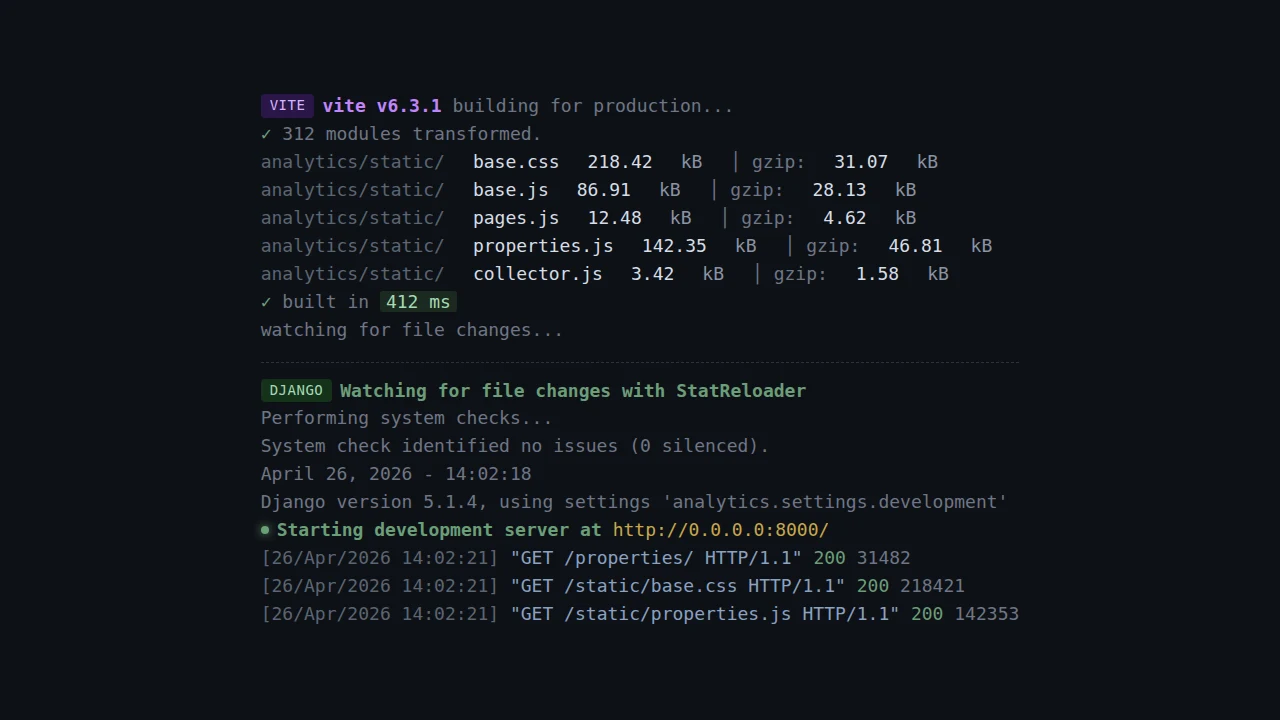
rollupOptions.input. Vite emits abase.js,pages.js,properties.js, andcollector.jsinto the same output folder and templates load whichever they need. entryFileNames: "[name].js"keeps output names predictable. WhiteNoise hashes them atcollectstatictime, so I don't need Vite to do it too.emptyOutDir: truewipes the output between builds. Vite refuses to clean a directory outside its project root unless you set this, so without it you get a warning every build and stale files pile up.
Django settings
I don't use django-vite or any other integration package. Django doesn't need to know Vite exists, it sees a static directory full of pre-built files and serves them.
STATICFILES_DIRS points at Vite's output directory so collectstatic and the dev server pick it up. CompressedManifestStaticFilesStorage hashes every file during collectstatic and rewrites references in CSS to point at the hashed names. Don't append ?v=... query strings to {% static %} — WhiteNoise expects to control the URLs and the manifest will get out of sync.
Templates stay boring:
In dev that resolves to /static/base.css. In production WhiteNoise rewrites it to /static/base.abc123.css automatically.
Running Django and Vite together
Vite has a watch mode that rebuilds on every change. I run it next to Django's runserver from a Makefile:
make -j2 runs both targets in parallel in the same terminal. The dev script in package.json is just vite build --watch:
I don't use Vite's dev server. It's great for SPAs but on a Jinja-rendered page HMR doesn't really do anything, and you've added an extra port and an integration layer for no reason. vite build --watch writes plain files to disk that look identical to what production serves. Hard refresh in the browser, same as webpack always was.
If you really want HMR, django-vite is the package most people reach for and it works well. I just don't think it's worth the extra dependency for a multi-page app.
Per-app static_src
For the analytics dashboard the entry point looks like:
And in the dashboard template:
New JS for an app goes in that app's static_src/ and shows up as <app-name>.js in the static directory. No webpack chunks config, no splitChunks, no Babel preset to keep current.
Production
The Dockerfile runs bun run build once during the image build, then collectstatic. After that there's no Node or Vite at runtime, just Gunicorn serving Django and WhiteNoise serving the hashed files.
Total build time across bun install, vite build, and collectstatic is under 30 seconds on these projects. Webpack used to take three or four minutes.
Sources
Honza Hrubý's "Goodbye Webpack, Hello Rspack" is the case for the drop-in path if a full migration isn't realistic. Ratchapol Thaworn's "Migrating from Webpack to Vite" and HK Lee's "Vite vs. Webpack in 2026" go further on the Vite side. The Vite docs and the django-vite README are the references I keep open when I'm actually wiring it up. Saas Pegasus has a longer Django + Vite walkthrough too if you want one with React and Tailwind on top.
Webpack served me well for a long time. I just don't have a reason to keep using it.