 Isaac Bythewood
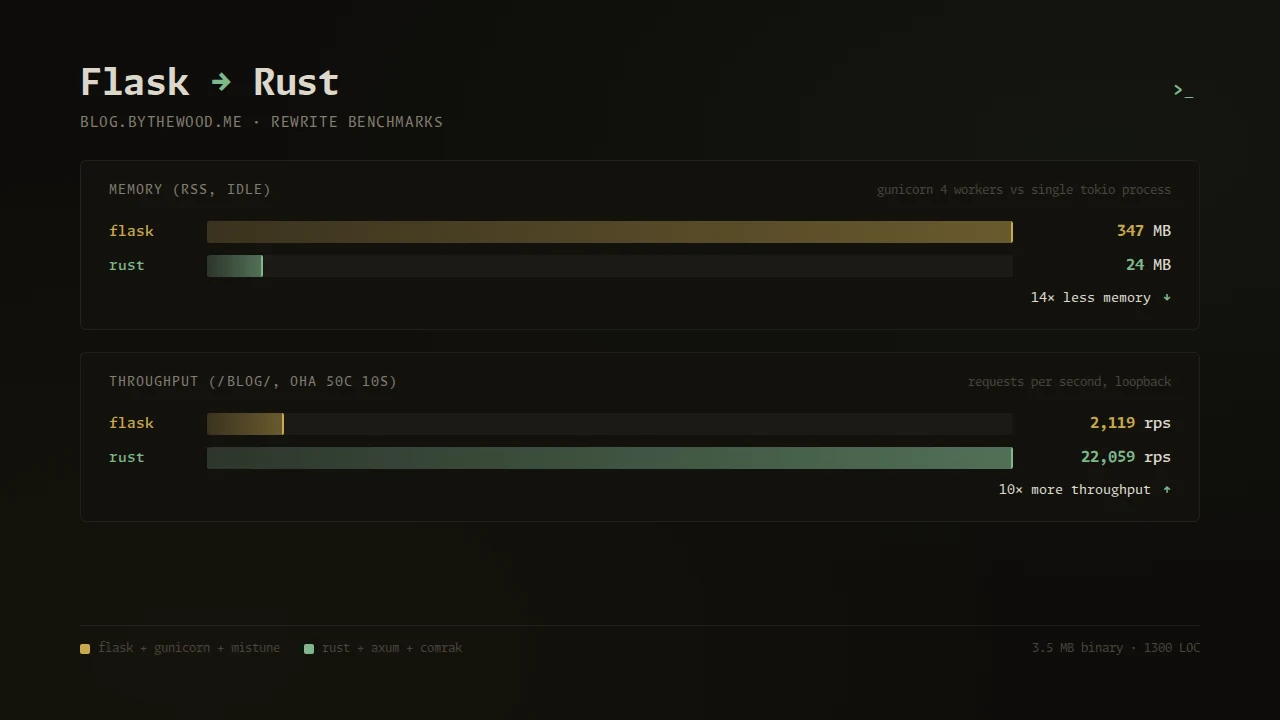
A few days ago I rewrote this blog from Flask to Rust and wrote up the benchmarks. What I didn't get to was that a day later I deleted chrome-headless-shell from the runtime image and replaced it with Typst embedded as a library, which took most of a gigabyte off the Docker image without really changing the PDF route.
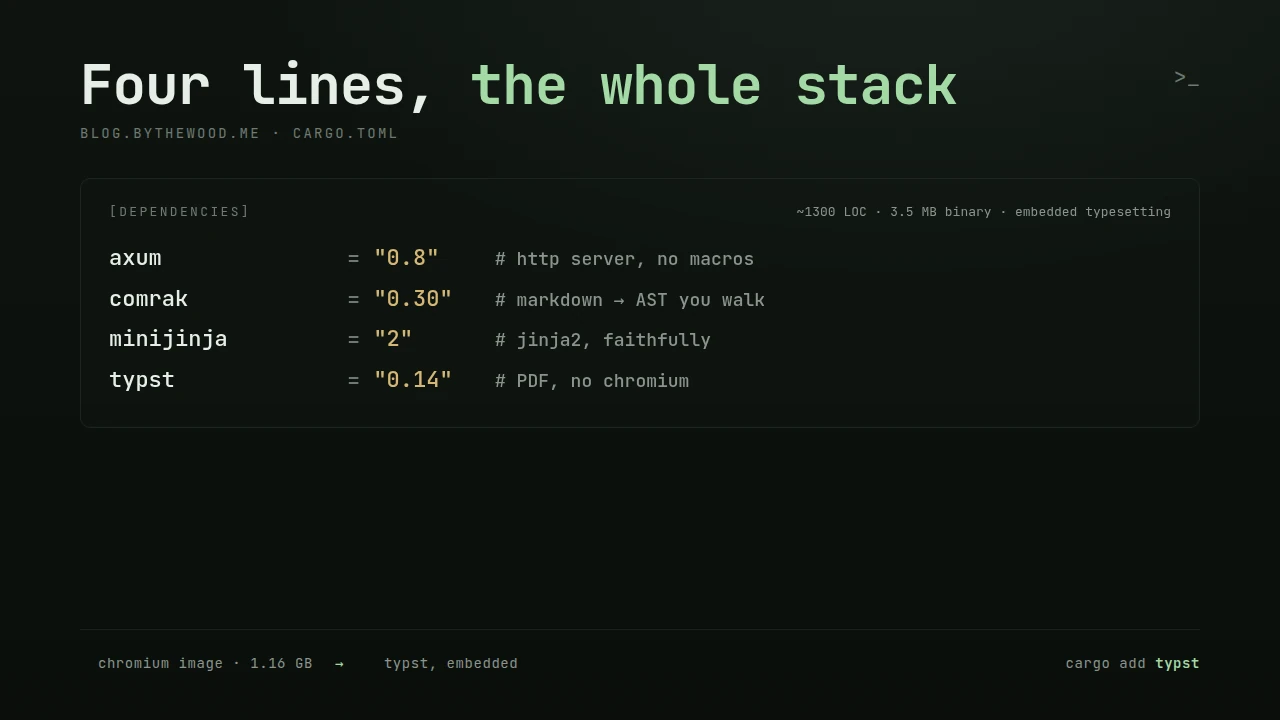
So this is the follow up, a closer look at the four crates the blog actually runs on.
axum
axum is pretty small. A handler is an async function, its arguments are extractors, and its return type implements IntoResponse.
pub async fn show(
    State(s): State<AppState>,
    Path(slug): Path<String>,
) -> impl IntoResponse {
    // ...
}
State is a clone-cheap struct, Arc'd once at startup. Routers compose with merge, so I keep one router file per feature (routes/post.rs, routes/blog.rs, routes/search.rs, routes/seo.rs) and stitch them together in app.rs:
Router::new()
    .merge(routes::home::router())
    .merge(routes::blog::router())
    .merge(routes::post::router())
    .merge(routes::search::router())
    .merge(routes::seo::router())
    .nest_service("/static", static_files)
    .nest_service("/content/images", images)
    .fallback(routes::errors::not_found)
    .layer(axum_middleware::from_fn(log_requests))
    .with_state(state)
Middleware is a tower layer, so request logging, cache headers on static files, and the 404 fallback all end up the same shape. The whole request logger is about twenty lines.
pub async fn log_requests(req: Request, next: Next) -> Response {
    let method = req.method().clone();
    let path = req.uri().path_and_query()
        .map(|p| p.as_str().to_string())
        .unwrap_or_default();
    let start = Instant::now();
    let response = next.run(req).await;
    let elapsed_ms = start.elapsed().as_secs_f64() * 1000.0;
    let status = response.status().as_u16();
    eprintln!("{method:<5} {status} {elapsed_ms:>7.2}ms  {path}");
    response
}
I haven't pulled in tracing yet and I don't expect to.
comrak
comrak parses CommonMark + GFM into an AST. Most markdown libraries either render straight to HTML or hand back an event stream, which makes any non-trivial customization annoying, but comrak gives you the whole tree to walk.
I render every post twice from the same source. Once to HTML for /posts/<slug>/, once to Typst markup for /posts/<slug>/pdf/. Both walks read the same arena, so a typo in markdown fails both renders identically.
For HTML, comrak's create_formatter! macro overrides individual node types and inherits the rest. I use it to wrap blocks in div.block-* classes the CSS hooks into, the same shape the Mistune custom renderer in the Flask version produced. The Typst pass is a hand-written walker, about 250 lines in src/pdf.rs.
minijinja
I came in expecting to rewrite my templates and didn't have to. minijinja, by Armin Ronacher who also wrote Jinja2, is faithful enough that the entire templates/ directory came over with two whitespace tweaks and a parens fix on a ternary.
It has two rough edges.
- Jinja2 escapes
/in URLs to/and minijinja doesn't, which is technically more correct but it broke the OG image template and a couple of expected-string snapshots. About thirty lines of formatter to match Jinja2 sorted it out. - In debug builds, minijinja re-reads templates from disk on every render. Gate the loader on
cfg(debug_assertions)and you get template hot-reload without restartingcargo run.
Typst, embedded
Typst is a typesetting system, and the part I care about is that the entire compiler is on crates.io as typst, typst-pdf and typst-kit for font discovery. That means there's no binary to ship alongside the app and no subprocess to manage. You call typst::compile(&world) and get back a PagedDocument, then typst_pdf::pdf(&doc, ...) and get bytes.
End to end:
let main = Source::new(
    FileId::new(None, VirtualPath::new("/main.typ")),
    source,
);
let world = PdfWorld { library, book, fonts, root, main };
let document = typst::compile::<PagedDocument>(&world).output?;
let bytes = typst_pdf::pdf(&document, &PdfOptions::default())?;
The type that took me a minute was World, which is the trait Typst uses to ask for the source of a file id, the bytes of an asset, a font by index, or today's date. You implement it once. Mine resolves Typst paths against the project root, so a snippet like this:
#image("/content/images/cover.webp")
reads content/images/cover.webp from the running binary's working directory, and it behaves the same on macOS, alpine and CI without any bind mounts or temp files.
Fonts are found once at startup with typst-kit's FontSearcher. The runtime alpine image installs font-jetbrains-mono, ttf-dejavu, and ttf-liberation so there's always a sans, mono, and fallback available.
The size difference is what got my attention. The chromium runtime image was 1.16 GB and the Typst image is a few hundred MB, most of which is the font packages. The PDF route used to spawn a process and write a temp file and now it's just a function call. Every other PDF tool I've shipped, WeasyPrint and wkhtmltopdf and headless Chromium, added a binary to the runtime image and a process boundary at request time.
What I keep noticing
Coming from uv on the Python side, cargo add and Cargo.lock felt familiar, since uv already does the single tool and single lockfile thing for Python. What you give up is build time. A Docker image for this blog takes tens of seconds to build incrementally and a couple of minutes cold, where the Flask and uv version was a few seconds either way. What I get back is a binary that idles at 24 MB and serves an order of magnitude more traffic, which seems worth it to me.
Underneath axum, comrak, minijinja, and typst, the project pulls in tokio for the runtime, tower-http for middleware and static files, serde for frontmatter parsing, chrono for dates, and anyhow for error handling. The whole Cargo.toml fits on a screen.
Every time I've gone looking for something in Rust so far there's been a decent answer sitting there already, which is more than I expected going in.